
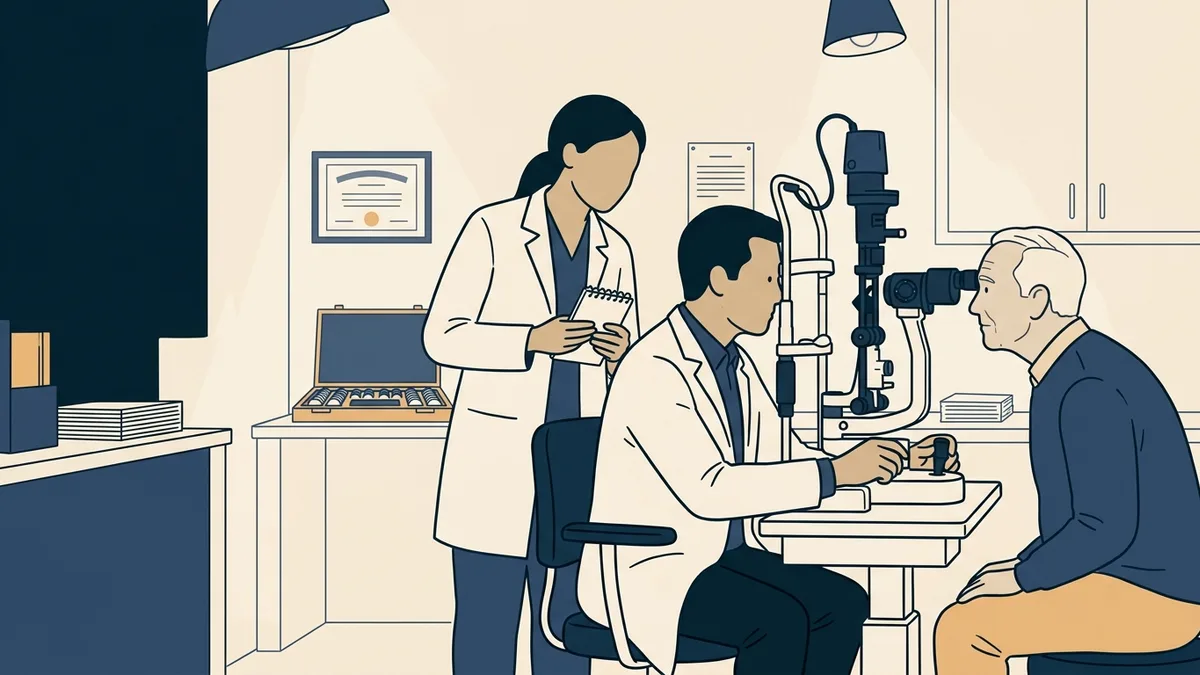
Arkansas licenses out-of-state optometrists by endorsement at the board's discretion after three of the last four years in practice. Applicants interview in person at a board meeting and take the Arkansas jurisprudence exam the same day. Optometric physician certification rests on a 100-hour internship logged under a board-certified ophthalmologist.
Arkansas is an endorsement state with two features you will not find in most others. First, the endorsement itself is discretionary and personal: after three of the last four years in practice, you appear in person before the Arkansas State Board of Optometry for an interview and take the Arkansas jurisprudence exam the same day. Second, the level of practice most optometrists expect, optometric physician certification, carries its own requirements under the board's rules, including a 100-hour internship logged under a board-certified ophthalmologist. Neither step can be rushed, because both run on the board's meeting calendar.
The details below come from the board's rules (Chapter I, Article IV and Chapter V), the endorsement application, the board's 2026/2027 fee schedule and its website.
Who qualifies for Arkansas endorsement?
The board's rules say a person from another state "may be issued a licensure by endorsement at the sole discretion of the State Board of Optometry" on satisfactory proof that they:
- are qualified under the chapter;
- hold a certificate or license from a state, territory, the District of Columbia or Canada "having standards of proficiency at least equal to the standards of Arkansas";
- have "engaged in the lawful practice of optometry for a period of three years of the past four years" in that jurisdiction and complied with Arkansas licensure law at the time of application; and
- have passed an Arkansas jurisprudence exam approved by the board.
So Arkansas is not a "no years" state. A new graduate, or an OD who took a long break, applies by examination instead. For how other boards count practice years, see how states count years of practice for endorsement.
Which documents go in the endorsement application?
The board's endorsement application and rules list:
- The application, with a head shot or passport photo taken within the last year, signed under penalty of perjury.
- The fee. The board's 2026/2027 fee schedule lists License by Endorsement at $438 including the background check fee; the application form asks for $438.50, covering registration and the criminal background check.
- Official transcripts sent directly from your undergraduate schools and your optometry school.
- A certificate of good standing from each state where you are licensed, setting out your history with that board.
- Copies of your therapeutic license or licenses.
- Proof that you passed every part of the NBEO exam required at the time you graduated, sent directly to the board.
- Current CPR certification.
- Malpractice claim information, if any.
- A signed authorization and fingerprint cards for the Arkansas State Police and FBI check. The board sends the cards after it receives the application and fee.
The form also asks whether you have taken, or plan to take, state board exams elsewhere, and whether any license was ever revoked or suspended. It includes an agreement "to meet with and submit to questions regarding my qualifications as an applicant by the Board or any member thereof."
How do the interview and jurisprudence exam work?
Once the file is complete, the board office gives you a meeting date. The application's checklist lists the remaining steps: an interview with board members at a State Board of Optometry meeting, the Arkansas jurisprudence exam "same day as interview," and then the Optometric Physician Application, provided after the exam, with a $50 fee. The board's website lists its upcoming dates "By Examination and Endorsement":
- November 19, 2026
- June 10, 2027, which also covers Advanced Procedures Certification
- November 18, 2027
The board notes that testing dates and licensing depend on finishing the application requirements. With two endorsement dates a year, an application completed just after one date waits months for the next. States that require a state exam or a board interview compares Arkansas with the other interview and exam states.
What is optometric physician certification, and where does the 100-hour log come in?
Chapter V of the board's rules sets the requirements for an optometrist certified as an optometric physician. For optometrists who applied for Arkansas licensure after February 17, 1997, the rules require passing all parts of the NBEO exam, a state board test in general and ocular therapy and pharmacology, a state board test on jurisprudence and any other tests the board requires, and completion of "the 100 hour internship program." Article III of that chapter defines the internship:
- At least 100 hours of supervised clinical training in the examination, diagnosis and treatment of conditions of the eye, lid and adnexa.
- Supervision by a board-certified ophthalmologist, who certifies the hours.
- Hours recorded in the logbook provided by the board, with the board certifying that the 100-hour minimum was met.
The board's tests for optometric physician certification cover rules and regulations, federal controlled substance regulations, jurisprudence, the impaired provider program and prescription writing. The endorsement checklist does not say whether an endorsement applicant also sits the board's therapy and pharmacology test or whether an internship completed elsewhere counts, so ask the board office before you schedule anything. If you have to arrange 100 supervised hours with an ophthalmologist, that is the long pole in an Arkansas move.
What can an Arkansas optometric physician do?
The Arkansas practice act, Ark. Code Ann. section 17-90-101(a)(3), includes prescribing and administering oral and topical drugs for conditions of the eye, lids and adnexa, and, under subdivision (D), injections (excluding intravenous or intraocular), chalazion incision and curettage, removal and biopsy of certain low-risk skin lesions, laser capsulotomy and laser trabeculoplasty. Section 17-90-206 requires optometrists certified for laser procedures to report outcomes to the board, and the board's fee schedule lists a separate Advanced Procedures License. Schedule I and II drugs are excluded except hydrocodone combination products, limited to a 72-hour supply with no refills. For how Arkansas compares with other states, read how states decide on laser procedures.
Who is responsible for renewing an Arkansas license?
You are, by rule. Licenses expire at midnight on February 1 each year, the renewal fee is $150, and only renewals received by the deadline count, "regardless of postmark." Chapter I, Article V then states: "The responsibility of timely renewal is placed entirely upon the holder of the license, and shall not be transferred to any employee, firm, agent, or other third party, including the postal service." That is why we track Arkansas deadlines and remind, and you renew. Late renewals carry an added fee. The optometric physician certificate also expires February 1 and renews on proof of 20 hours of CE in the preceding 12 months, half in general and ocular therapy and pharmacology; out-of-state CE must be COPE approved. See keeping several optometry renewals on one calendar.
Does Arkansas allow tele-optometry?
Yes, under the conditions in Chapter I, Article XIV of the board's rules. A proper optometrist-patient relationship must exist before care is delivered by tele-optometry, and the rule says a patient completing an optometric history online and forwarding it "is not sufficient to establish the relationship." Tele-optometry is held to the same standard of care as in-person visits, and an optometrist may not prescribe Schedule II through V medications by tele-optometry without an in-person exam or one of the listed existing relationships. Tele-optometry: which state licenses you need covers the multi-state view.
Should you plan Arkansas with a licensing service?
Arkansas is an Exam or Interview State License Application, which is $799. We confirm your three-of-four-years history, prepare the endorsement application with a question-by-question guide, request good-standing certificates and NBEO scores, track the fingerprint cards, target the next board date and get you the board's jurisprudence materials. If you need the optometric physician internship, we help you document the logbook requirements and ask the board the questions above in writing. You sign the application under penalty of perjury, attend the interview, sit the jurisprudence exam, complete the internship hours and renew each year yourself. See the Arkansas licensing page to compare states.
Common questions
- How many years of practice does Arkansas require for endorsement?
- Three of the past four years of lawful practice in a state, territory, DC or Canada with standards at least equal to Arkansas's. Endorsement is at the board's sole discretion.
- When are the Arkansas optometry board dates for endorsement?
- The board's website lists November 19, 2026, June 10, 2027 and November 18, 2027 for examination and endorsement. The June date also covers Advanced Procedures Certification.
- Can a service renew my Arkansas optometry license for me?
- No. Arkansas board rules say timely renewal is entirely the license holder's responsibility and cannot be transferred to any employee, firm, agent or other third party. A service can remind you and track the deadline; you renew.
- What is the 100-hour internship in Arkansas?
- At least 100 hours of supervised clinical training under a board-certified ophthalmologist, recorded in the board's logbook. The board's rules require it for optometric physician certification.
Need Help with Your Application?
We prepare the optometry licensing process end-to-end — eligibility screening, documents, board follow-ups, and tracking.