North Carolina, Alaska's exam route, West Virginia and, from Jan. 1, 2027, Kentucky's standard application require NBEO's Injections Skill Examination. The Laser and Surgical Procedures Examination appears in laser credentials in West Virginia, South Dakota, Virginia and, from July 2028, Vermont, and Washington accepts either exam for advanced procedures.
For most of optometry's history, NBEO's three-part series was all a board asked to see. Two newer exams have changed that. The Injections Skill Examination (ISE) tests clinical injection skills. The Laser and Surgical Procedures Examination (LSPE) tests laser and minor surgical procedures. Some boards now require one or both for a license, others for an advanced procedures credential, and a few accept a board-approved course instead. If you are licensing in another state, check both lists before you assume your file is complete.
What do the two exams test?
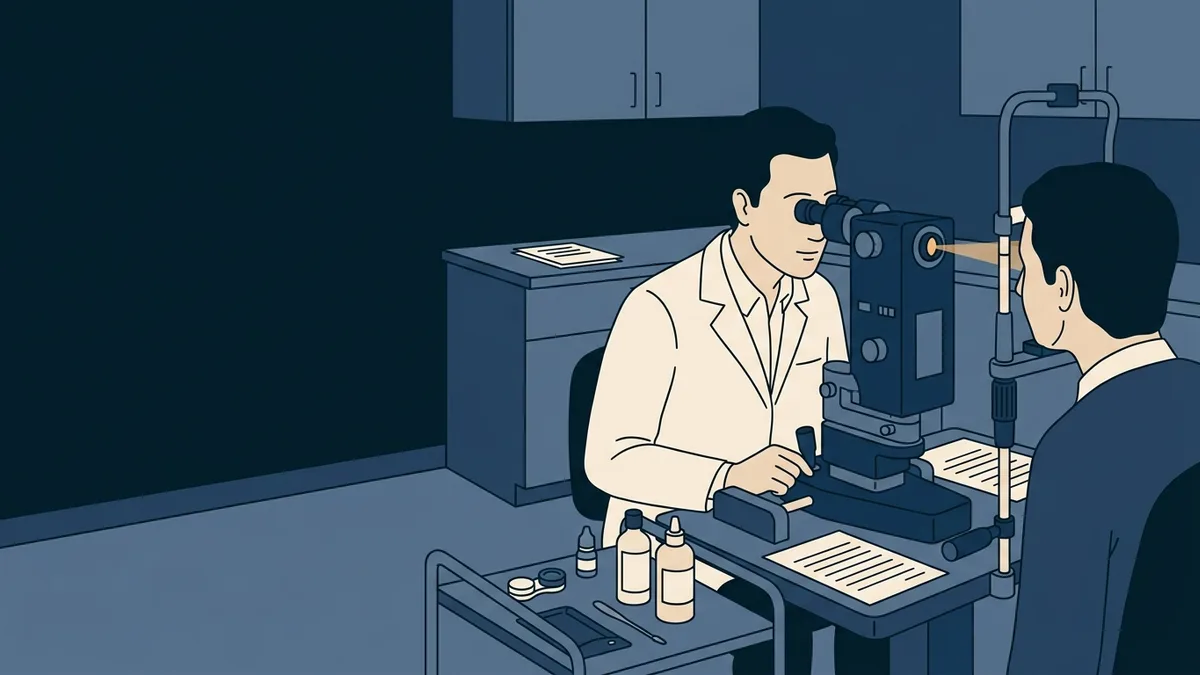
The ISE is a clinical skills exam given at NBEO's National Center of Clinical Testing in Optometry (NCCTO) in Charlotte, in exam rooms set up to simulate real optometric exam rooms. For exams given from August 2026 it costs $350.
The LSPE is a hybrid exam, a clinical skills portion plus a multiple-choice portion, also given at the NCCTO. It has two sections, registered and scheduled separately:
- Laser Section: selective laser trabeculoplasty (SLT), laser peripheral iridotomy and YAG capsulotomy, performed and tested in multiple choice.
- Surgical Section: suturing and chalazion excision, with multiple-choice items on suturing, eyelid surgery, injections and anesthesia.
Each LSPE section costs $1,270 from August 2026. NBEO offers the LSPE to fourth-year students, residents and practicing optometrists, and allows six attempts on each section. Unlike the licensure parts, the LSPE is not limited to candidates taking it for licensure purposes.
Which states require the ISE?
- North Carolina requires passing scores on Parts I, II, every Part III PEPS section, TMOD and the ISE. Earlier candidates need every part offered when they tested, plus the ISE. North Carolina has no endorsement route, so licensed optometrists sit its exam too. See North Carolina optometry licensing.
- Alaska's exam route needs Parts I, II and III, the ISE and TMOD, all passed within the four years before applying. Its license-by-credentials route asks instead for a board-approved nontopical injection course of at least seven hours taken after optometry school.
- Kentucky's standard application requires the ISE from Jan. 1, 2027 (201 KAR 5:010E).
- West Virginia requires the ISE or a board-approved injection course, as part of the oral, injection and laser certification every applicant must hold before applying.
Which states ask for the LSPE?
Where the LSPE appears, it is tied to laser authority that the state's own statute or rule grants. Read these as credential requirements, not as a list of every state where optometrists perform laser procedures.
- West Virginia asks for the LSPE or a board-approved laser course, and graduates after May 1, 2025 need the LSPE or a postgraduate laser course. Laser certification covers YAG capsulotomy, SLT and peripheral iridotomy, and full certification takes 5, 5 and 4 proctored procedures on a live eye (W. Va. Code 30-8B). See West Virginia licensing: ISE, LSPE and five years.
- South Dakota brought SLT and YAG capsulotomy into scope on July 1, 2024, after board certification only. Graduates after that date need the LSPE to add advanced procedures, along with a board-approved course of at least 32 hours and proctored competency on live eyes, ten eyes for YAG capsulotomy (SDCL 36-7-1.4).
- Virginia issues a separate laser surgery certification that needs a dean or course attestation covering 12 topics plus the LSPE laser section or proctored sessions (18VAC105-20-80). From Jan. 1, 2033, every applicant must meet that requirement. See Virginia licensing and the 2033 laser rule.
- Vermont created an Advanced Therapeutic Procedures Specialty License (Act 171, signed June 18, 2026). From July 1, 2028, holders may perform laser capsulotomy, peripheral iridotomy and trabeculoplasty after a 32-hour course, supervised procedures on live patients, and the NBEO ISE and LSPE. See Tennessee's and Vermont's laws taking effect in 2028.
- Washington has an advanced procedures endorsement for chalazion removal, injections, lid lesions and eyelid surgery that requires a hands-on course, a national exam such as the ISE or LSPE, and a physician rapid-response agreement. It includes no laser procedures.
Do any boards test these skills themselves?
Yes. Louisiana's own licensing exam, given once a year in July in Shreveport, includes a practical with YAG capsulotomy, YAG iridotomy, SLT, injection and lid stations. Oklahoma requires every candidate to pass the Laser Therapy for the Anterior Segment course at Northeastern State University, or to be a graduate of NSU's Oklahoma College of Optometry, before sitting its State Board Exams. Mississippi's optional Primary Eyecare Procedures certification ($750), which covers YAG posterior capsulotomy, uses a board course, a written exam, a skills assessment and eight preceptor hours. Oregon's ATI certification adds injections after a board-approved injection course.
How does the timing work?
Clinical exam results arrive on NBEO's schedule, not the board's. NBEO releases Part III PEPS, ISE and LSPE scores in the first full week of a set month, roughly two months after the exam: an August exam is released in October, a December exam in February, a May exam in July. If a state needs the ISE or LSPE before it will process your file, as West Virginia does, book the exam well ahead of your target start date.
Registration is your own. NBEO accounts belong to the candidate, and NBEO's eligibility policy limits the ISE, like the three licensure parts, to candidates taking it for licensure purposes. A passed exam cannot be retaken unless a state board asks in writing or the candidate submits a notarized affidavit, and NBEO grants an exception.
How do we handle advanced procedure credentials?
The readiness review checks whether your target state requires the ISE or LSPE for the license, for a credential, or not at all, and whether a board-approved course is accepted instead. Our Laser and Advanced Procedure Credential service is $399 per state: we assemble course certificates, proctor logs, physician agreements and the NBEO score report into the board's credential application, and you sign it. You register for and sit each exam yourself. See pricing or how states decide on laser procedures.
Common questions
- How much do the ISE and LSPE cost?
- For exams given from August 2026, NBEO charges $350 for the ISE and $1,270 for each LSPE section, laser and surgical. Both are given only at the NBEO testing center in Charlotte, North Carolina.
- Do I need the LSPE to get licensed in West Virginia?
- West Virginia requires the LSPE or a board-approved laser course before you apply, and graduates after May 1, 2025 need the LSPE or a postgraduate laser course.
- Can a practicing optometrist take the LSPE?
- Yes. NBEO offers the LSPE to fourth-year students, residents and practicing optometrists, and the laser and surgical sections can be scheduled on the same day or separately.
- When are ISE and LSPE scores released?
- NBEO releases clinical exam scores in the first full week of a set month, about two months after testing. An August exam is released in October and a May exam in July.
Need Help with Your Application?
We prepare the optometry licensing process end-to-end — eligibility screening, documents, board follow-ups, and tracking.