
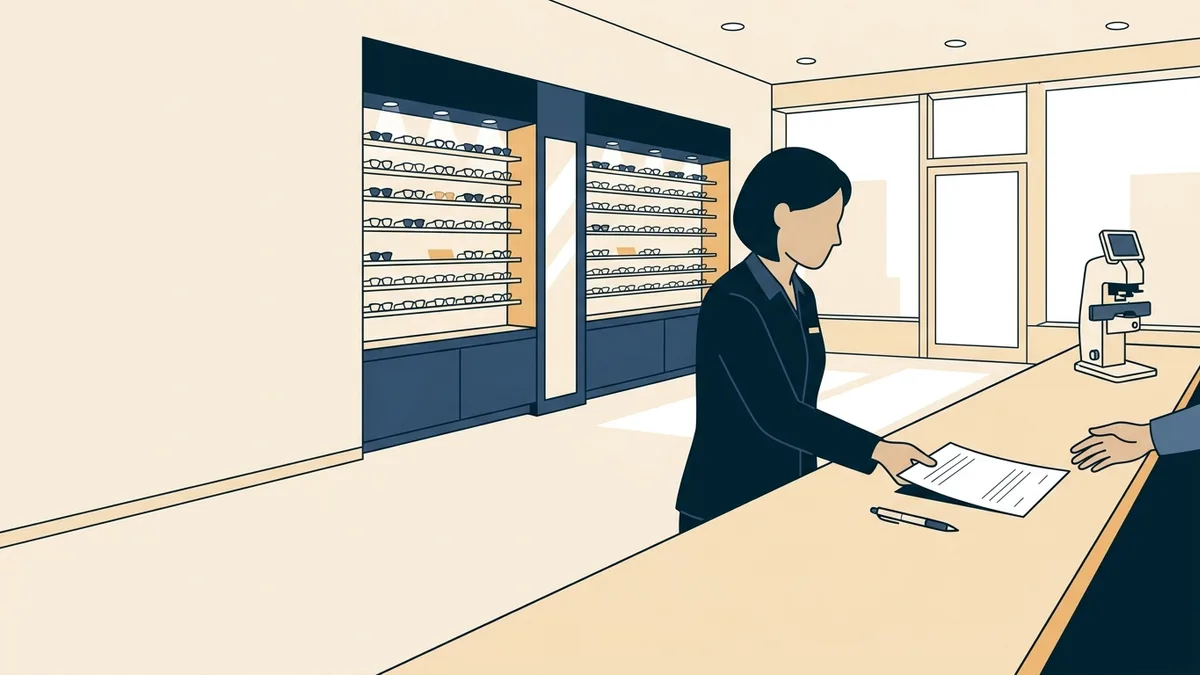
Since Sept. 24, 2024, the amended Eyeglass Rule requires prescribers to release the eyeglass prescription immediately after the refractive exam, on paper or digitally with the patient's verifiable consent, and, unless they have no financial interest in eyewear sales, to get a signed confirmation or keep delivery evidence for three years (16 CFR 456.2 to 456.4).
The Eyeglass Rule is one of the few federal rules that applies to every optometrist in every state, whatever the state license says. It was amended in a final rule published July 26, 2024 (89 FR 60742), effective Sept. 24, 2024. The amendments kept the core duty, releasing the prescription, and added a paper trail. For an optometrist who practices in more than one state, it is one of the few rules that is identical in each of them.
What must a prescriber do after a refractive exam?
Under 16 CFR 456.2(a)(1), it is an unfair practice for an optometrist or ophthalmologist to fail to give the patient one copy of the prescription "immediately after the refractive eye examination is completed and before offering to sell the patient ophthalmic goods, whether or not the prescription is requested by the patient." The copy may be on paper, or digital if the patient has given verifiable affirmative consent.
A refractive eye examination is "the process of determining the refractive condition of a person's eyes or the presence of any visual anomaly by the use of objective or subjective tests" (§ 456.1(b)). The 2024 amendments changed the rule's wording from "eye examination" to "refractive eye examination" throughout.
Which practices does the rule forbid?
- Condition the exam on a purchase. A refractive exam may not be offered only to patients who agree to buy glasses from the prescriber (§ 456.2(b)).
- Charge to release the prescription. No fee beyond the exam fee may be required to release it. A separate fee for verifying glasses bought elsewhere is allowed if it is charged when the verification is performed (§ 456.2(c)).
- Use waivers. The prescription may not carry, and the patient may not be asked to sign, any waiver of the prescriber's responsibility for the exam's accuracy or for goods dispensed by another seller (§ 456.2(d)).
There is one payment exception. A prescriber may hold the prescription until the exam is paid for, but only if the prescriber would have required immediate payment had the exam shown no need for glasses. Since 2024 the rule says proof of insurance coverage counts as payment (§ 456.2(a)(2)).
Which duties did the 2024 amendments add?
Confirmation of release (§ 456.4). After giving the prescription, the prescriber must either:
- for a paper copy, ask the patient to sign a separate statement, on paper or digitally, confirming receipt; or
- for a digital copy, keep evidence that the prescription was sent, received or made accessible, downloadable and printable.
The rule offers optional wording: "My eye care professional provided me with a copy of my prescription at the completion of my examination." If the patient declines to sign, the prescriber notes the refusal on the document and signs it. The records must be kept for at least three years and be available to the FTC.
Digital delivery (§ 456.3). To deliver the prescription digitally, the prescriber must tell the patient which method will be used, such as text message, email or a patient portal, obtain the patient's verifiable affirmative consent to that method on paper or digitally, and keep the consent records for at least three years.
Who is exempt from the confirmation requirement?
Prescribers who have no direct or indirect financial interest in selling eyewear. The rule spells out that a financial interest includes "an association, affiliation, or co-location with an optical dispenser" (§ 456.4(c)). An optometrist employed in a practice with an optical shop, or working beside a retail optical store, should assume the confirmation duty applies. Separately, the whole rule does not apply to optometrists employed by a federal, state or local government entity (§ 456.5). The release duty in § 456.2 applies to everyone else, exempt from confirmation or not.
How does this play out across several states?
The federal duty is the same everywhere, but it sits next to state law, and states add their own prescription rules. South Carolina, for example, requires a glasses or contact lens prescription to carry an expiration date one year from the exam or a statement of why a shorter period is medically appropriate, and bars prescriptions generated by a kiosk (S.C. Code 40-24-20). New Hampshire lets a telemedicine exam support a glasses prescription only under listed conditions, including New Hampshire licensure. An optometrist practicing in several states needs one federal release process and a short list of state additions for each state. See South Carolina's kiosk rule.
For tele-optometry, digital delivery is the natural method, which makes the § 456.3 consent record and the § 456.4 evidence of delivery part of the visit workflow in every state. The FTC can inspect both. More in tele-optometry licensing.
Is the Eyeglass Rule related to the Contact Lens Rule?
They are siblings. The Contact Lens Rule (16 CFR part 315) has its own release, confirmation and verification duties, including a confirmation requirement added in 2020, and it expressly preempts some state laws. § 456.7 points to it for contact lens prescriptions. See the Contact Lens Rule and state law.
Why does this belong on a licensing site?
Because compliance follows the license. A complaint about an unreleased prescription can reach the board in the state where the patient was seen, and a multi-state optometrist answers to each of those boards. We do not run release workflows, but the readiness review ($149) and the Tele-Optometry Package (from $1,899 per optometrist) include a check of each target state's prescription rules, and our Annual Renewal & CE Tracking ($299 per license, per year) keeps each state's license current. See pricing.
Common questions
- When did the amended Eyeglass Rule take effect?
- The final rule was published in the Federal Register on July 26, 2024 and took effect Sept. 24, 2024.
- Do I have to get the patient to sign for the prescription?
- If you have a financial interest in eyewear sales, including through affiliation or co-location with an optical dispenser, yes for paper copies. For digital copies you keep evidence it was sent or made accessible. Keep either for three years.
- Can I email the eyeglass prescription instead of printing it?
- Yes, if you tell the patient the delivery method, obtain verifiable affirmative consent to it, and keep the consent record for at least three years.
- Can I hold the prescription until the patient pays?
- Only if you would have required immediate payment had the exam shown no need for glasses. Proof of insurance coverage counts as payment.
Need Help with Your Application?
We prepare the optometry licensing process end-to-end — eligibility screening, documents, board follow-ups, and tracking.