
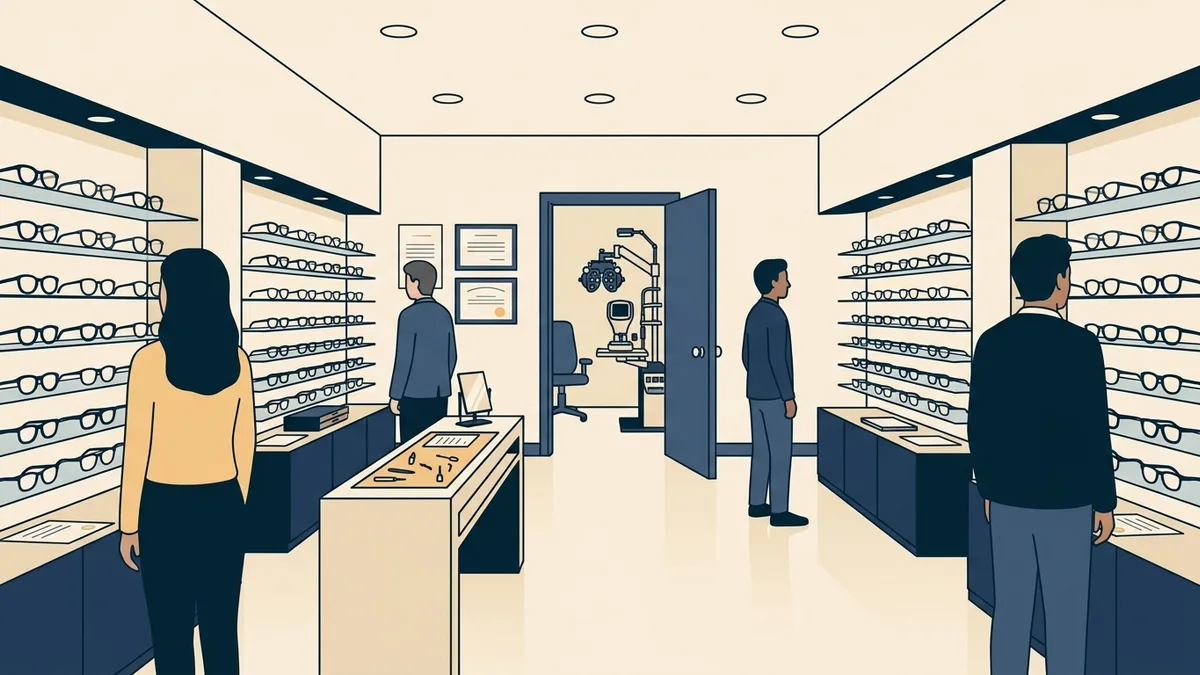
Each optometrist needs a license in every state where they see patients, and some states also regulate the location: Nevada licenses each practice location, New Jersey and North Carolina license branch offices, and New Hampshire and Mississippi restrict corporate ownership. Employers can prepare and track; each optometrist signs, sits exams and renews.
Optical retailers and multi-state eye care groups hire optometrists across state lines all the time, and they often move them between locations. Licensing does not move with them. Each optometrist needs a license in each state where they see patients, and a few states add rules about the location itself, who owns the practice and what each office needs. A licensing plan for a multi-state employer has to cover all three.
What does each optometrist need?
A license in every state where they examine patients, in person or by telehealth, and nothing transfers. There is no optometry compact, so a new state is always a full application: the route that state allows (NBEO scores, endorsement with years of practice, or a state exam), its law exam if it has one, fingerprints where required, and verifications from every state the optometrist has held. Our guide to how optometrists get licensed in another state walks through the routes.
For a roster, the useful habit is to collect each optometrist's NBEO history, license history and practice dates once, at hire, and keep them current. Most applications ask for the same facts in different formats.
Do some states regulate who owns the practice?
Yes, and retailers should read these before staffing a new state:
- New Hampshire: "No corporation shall engage in the practice of optometry," and no one may practice under an arrangement where a person not authorized to practice optometry shares in the fees (RSA 327:27).
- Mississippi: the practice must be owned by a Mississippi-licensed optometrist and stay free of lay or corporate control.
- North Carolina: the board publishes a policy on branch office licenses and the prohibition against corporate practice.
These are practice-structure questions for counsel, not licensing paperwork, but they decide whether the license plan works at all.
Which states license the location as well as the optometrist?
- Nevada licenses and renews each practice location separately. Renewal was $900 every two years for an active license and one location, plus $200 per added location, as of October 2026.
- New Jersey requires a certificate for each branch office, $250 initially and $250 every two years.
- North Carolina requires a licensee who practices in more than one office to obtain a branch office license for each additional location (G.S. 90-118.2), and treats a home office used for telehealth as a location that must be licensed.
- Michigan lets one controlled substance license cover prescribing at several locations, but each location where controlled substances are dispensed needs its own.
- Idaho requires optometrists who dispense drugs to hold a prescriber drug outlet registration from the Idaho Board of Pharmacy.
Why can the same optometrist have different privileges at two of your stores?
Because scope comes from each state's practice act. An optometrist who performs SLT at your Virginia location under Virginia's laser certification cannot do so at a Maryland or Pennsylvania store unless that state's law and board allow it. Prescribing differs too: Massachusetts limits optometrists to Schedule VI drugs, and Michigan bars Schedule 2. Clinical protocols, EHR order sets and scheduling templates should be set per state, not per optometrist. See how states decide on laser procedures and scope mismatches when moving.
Does the FTC Eyeglass Rule treat retail-affiliated optometrists differently?
Yes, on one point. Every prescriber must release the eyeglass prescription immediately after the refractive exam. The added duty to get a signed confirmation, or keep evidence of digital delivery, for three years applies to prescribers with a financial interest in eyewear sales, which the rule says includes "an association, affiliation, or co-location with an optical dispenser" (16 CFR 456.4). An optometrist in a retail optical store should assume it applies. See the Eyeglass Rule after 2024.
What can the employer do, and what must the optometrist do?
An employer can pay fees, gather documents, order verifications, schedule fingerprints and track deadlines. It cannot answer or sign the application. Texas has the applicant attest the information was "personally provided and reviewed by me," many states require sworn or notarized applications, and each optometrist sits every exam. Some boards will talk only to the applicant: Illinois communicates with an employer or credentialing service only if the applicant files the notarized third-party contact form IL486-2523, and Arizona sends status only to the applicant or one representative named in writing. Arkansas goes further on renewal, which "shall not be transferred to any employee, firm, agent, or other third party."
How do you keep a roster licensed?
- One record per optometrist per state, with route, status, issue date, renewal date, CE due and any state controlled substance license or DEA registration.
- Start new-state applications at offer, not at start date. Fingerprints, verifications and board meetings set the pace, and state-exam states such as North Carolina and Oklahoma run on fixed calendars.
- Separate the license from the location. Nevada, New Jersey and North Carolina location approvals have their own dates.
- Watch annual renewals. Arkansas, Kentucky, Maine, Massachusetts, Oklahoma, Virginia and West Virginia renew every year.
- Keep payer enrollment as a separate track that starts when each license issues. Our sister site covers group practice credentialing and rosters.
How do we help employers?
We work per optometrist: the Optometry License, One State service is $699 per state, $799 where a state exam or interview is required, and Annual Renewal & CE Tracking is $299 per license, per year. We prepare applications, coordinate verifications, fingerprints and score reports, and report status to you, while each optometrist reviews, signs and submits their own. For remote panels, see licensing a tele-optometry panel; for prices, see pricing.
Common questions
- Can an optical retailer apply for licenses on behalf of its optometrists?
- It can prepare and track them, but each optometrist answers and signs their own application, and several states require it sworn or notarized. Illinois will talk to an employer only after the optometrist files a notarized authorization.
- Which states license optometry office locations?
- Nevada licenses each practice location separately, New Jersey requires a certificate for each branch office, and North Carolina requires a branch office license for each additional location where a licensee practices, including a home telehealth office.
- Do any states prohibit corporate ownership of optometry practices?
- New Hampshire's statute says no corporation shall engage in the practice of optometry, and Mississippi requires practices to be owned by a Mississippi-licensed optometrist free of lay or corporate control. Have counsel review structure before entering those states.
- Does the FTC confirmation requirement apply to optometrists in retail stores?
- It applies to prescribers with a financial interest in eyewear sales, which the rule says includes association, affiliation or co-location with an optical dispenser.
Need Help with Your Application?
We prepare the optometry licensing process end-to-end — eligibility screening, documents, board follow-ups, and tracking.