
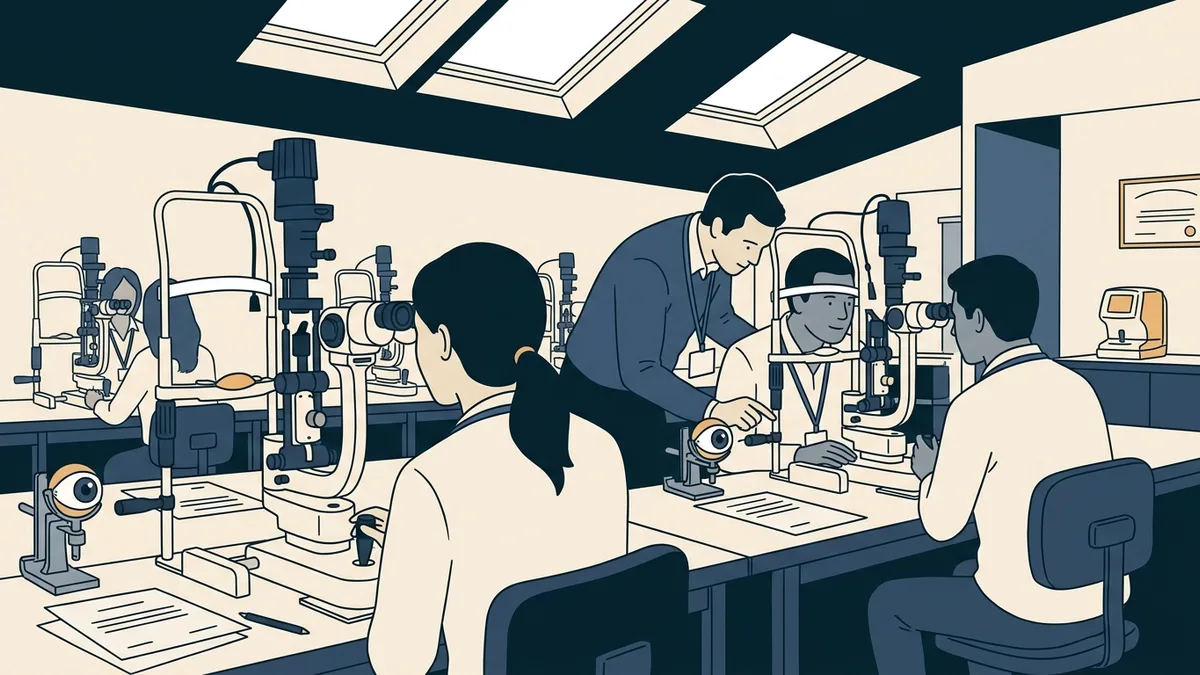
Among the states confirmed, requirements range from 16 hours a year in Louisiana to 50 every two years in California, Maryland, New Jersey, Ohio and Washington. States also set live-hour minimums, online and practice management caps, COPE-only rules and mandated topics such as Florida jurisprudence, Pennsylvania child abuse recognition and controlled substance prescribing.
Every state requires continuing education to renew an optometry license, and almost no two states ask for the same thing. The total hours differ, the cycle differs, and the fine print differs more: how many hours must be live, how many can be online, whether practice management counts, whether the course must be COPE-approved and which topics are mandatory. An optometrist licensed in three states is satisfying three rulebooks with one calendar of courses.
The table below collects the requirements we have confirmed from board pages, statutes and rules as of 2026. Where a state is missing, we have not confirmed it from a primary source.
What does each state require?
| State | Hours and cycle | Rules worth knowing |
|---|---|---|
| Alabama | 20 a year (Oct. 1 to Sept. 30), therapeutic licensees | At least 10 on eye disease; distance and practice management each capped at 3 |
| Alaska | 40 every 2 years | At least 24 in ocular pathology or pharmacology; at most 3 in practice management |
| Arizona | 32 every 2 years, by birthday | DEA holders include at least 3 in opioid, substance use disorder or addiction |
| Arkansas | 20 a year for optometric physicians (12 for others) | At least 12 live; out-of-state CE must be COPE approved |
| California | 50 every 2 years (TPA); 40 for non-TPA | 35 on ocular disease; TPG/TLG include 10 in glaucoma; no practice management courses |
| Colorado | 24 every 2 years (March 31 of odd years) | First renewals prorated |
| Connecticut | 20 a year | 6 in pathology, diabetes detection or ocular treatment; 6 in therapeutic agents; at least 10 live; at most 5 asynchronous and 6 practice management |
| Florida | 30 every 2 years (Feb. 28 of odd years) | 2 in Florida jurisprudence plus the medical errors requirement |
| Idaho | 18 each calendar year | At most 9 asynchronous |
| Louisiana | 16 a year (prior calendar year) | 8 in-person in pharmacology and ocular disease; at most 6 online; reported to OE TRACKER |
| Maine | 25 a year | At least 15 on ocular disease for advanced therapeutic licensees; up to 5 carry over |
| Maryland | 50 every 2 years (TPA) | 30 therapeutic; COPE or board-approved only; current CPR |
| Michigan | 40 every 2 years | 2 in pain and symptom management; 20 live or synchronous; 20 pharmacology for DPA/TPA |
| Missouri | 32 every 2 years | Includes 2 in Missouri jurisprudence |
| Montana | 36 every 2 years | License renews every year |
| Nebraska | 44 every 2 years | Home study capped at 8, practice management at 4, CPR at 2 |
| New Jersey | 50 every 2 years | At least 30 in TPA topics, 10 of them oral TPA |
| New York | 36 every 3 years (TPA) | Registration renews in the birth month |
| North Dakota | 40 every 2 years | Half in treatment and management of eye disease; logged in OE TRACKER; current CPR |
| Ohio | 50 every 2 years | 20 in pharmacology; no CE for the first renewal; no carryover |
| Oklahoma | 25 a year | At least 10 live classroom; up to 15 live virtual, 6 remote, 6 practice management |
| Oregon | 18 a year | At least 9 in TMOD; 1 cultural competency and 1 pain management every other renewal |
| Pennsylvania | 30 every 2 years | 2 in child abuse recognition; 6 pharmaceutical (T); 4 glaucoma (G) |
| Rhode Island | 20 a year | 10 in pharmacology for ocular conditions (amplified privileges) |
| South Carolina | 40 every 2 years | Under S.C. Code 40-37-240(D) |
| Tennessee | 40 every 2 years | 25 in ocular and systemic disease for therapeutic licensees, including 2 on controlled substance prescribing; CPR |
| Texas | 32 every 2 years | License renews every two years |
| Utah | 30 every 2 years | COPE or approved courses; includes a listed suicide prevention training |
| Vermont | 40 every 2 years | Current CPR; specialty holders add 5 from 2028 |
| Virginia | 20 a year | At least 10 real-time interactive; 10 in pharmacology or treatment for TPA; up to 10 carry forward |
| Washington | 50 every 2 years | License renews every year on your birthday; at least 10 in person; at most 25 asynchronous; jurisprudence exam counts for 3 |
| West Virginia | 40 every 2 years | 12 pharmacology, 2 injections, 2 laser or advanced procedures; at most 10 online; BLS |
| Wisconsin | 30 every 2 years | Renews Dec. 14 of odd years |
| Wyoming | 40 every 2 years | 15 ocular systemic therapeusis; 3 controlled substance prescribing; at most 6 practice management and 10 asynchronous |
Note that the CE period and the license term are not always the same. Montana, North Dakota, Washington, West Virginia and Wyoming renew licenses every year but count CE over two years, and Louisiana counts the prior calendar year.
Timing rules differ too. Iowa requires CE to be finished before you renew. Wyoming's license renews each April 1, but its 40 hours are due by Dec. 31 of odd years, so the CE deadline and the renewal deadline are months apart. North Dakota's renewal falls on Dec. 20 while its CE cycle runs two years, so check which year of the cycle you are in.
Where do the fine-print rules trip people?
Live and online limits
The same online course can count fully in one state and partly in another. Oklahoma needs at least 10 live classroom hours, Michigan 20 live or synchronous, Connecticut 10 live, Virginia 10 real-time interactive and Washington 10 in person. Idaho caps asynchronous hours at 9, Wyoming at 10 and Louisiana's online hours at 6.
Practice management
California does not accept practice management courses at all, even with COPE approval. Alabama, Alaska, Maine, Nebraska, Oklahoma, Connecticut and Wyoming cap them between 2 and 6 hours.
Who approved the course
Maryland accepts only COPE-accredited or board-approved programs, Arkansas requires COPE approval for out-of-state CE, and Utah accepts COPE or approved optometry courses. Louisiana does not accept a letter from another state board listing CE hours.
Mandated topics
Florida requires Florida jurisprudence and medical errors hours, Missouri 2 hours of Missouri law, Pennsylvania child abuse recognition, Michigan pain management and implicit bias, Oregon cultural competency and pain management, Utah suicide prevention, Tennessee and Wyoming controlled substance prescribing, and West Virginia injections and laser. These state-specific courses rarely count anywhere else, so budget them per state.
CPR and BLS
Maryland, North Dakota, Oklahoma, Tennessee and Vermont want current CPR at renewal, and West Virginia current BLS. Oregon says CPR does not count toward CE hours.
Can one set of courses satisfy several states?
- Start with the strictest topic rules. Book each state's mandated topics first, since nothing else substitutes.
- Choose COPE-approved, live or synchronous courses for the core ocular disease and pharmacology hours. They count in the most states.
- Line up the periods. A course taken in January may fall in one state's cycle and outside another's. Ohio's period runs Jan. 1 of odd years to Dec. 31 of even years; Alabama's runs Oct. 1 to Sept. 30.
- Keep the certificates. OE TRACKER stores COPE course history and many boards accept its transcript, but some boards still want certificates, and state-specific courses may not appear there. See OE TRACKER and how boards audit CE.
- Use first-renewal relief where it exists. California exempts new licensees issued within a year of graduation for their first renewal, Ohio requires no CE for the first renewal, Colorado prorates, and Florida's first-cycle licensees owe only the HIV/AIDS hour.
Is there a penalty if the hours fall short?
Most boards make you certify completion at renewal and audit afterward. A false certification is itself grounds for discipline in Pennsylvania, and Alabama warns that failing to show proof can lead to penalties including suspension. Ohio charges $125 for late CE. Fix shortfalls before renewal, not after; see reinstating a lapsed optometry license for what happens when a license lapses.
How can we help?
Our Annual Renewal & CE Tracking service ($299 per license, per year) maps each of your states' hours, periods, live and topic rules onto one plan and reminds you ahead of each deadline. You choose and complete the courses and renew each license yourself. See pricing, keeping several renewals on one calendar and PDMP and opioid CE.
Common questions
- Does practice management CE count for optometry license renewal?
- It depends on the state. California does not accept practice management courses at all, and Alabama, Alaska, Maine, Nebraska, Oklahoma, Connecticut and Wyoming cap them between 2 and 6 hours.
- Can I do all my optometry CE online?
- Not in most states. Oklahoma requires at least 10 live classroom hours, Michigan 20 live or synchronous, Washington 10 in person, and Idaho and Wyoming cap asynchronous hours.
- Do states accept CE taken for another state's license?
- General COPE-approved courses usually count in several states, but state-specific mandated topics such as Florida jurisprudence or Missouri law rarely count elsewhere. Check each state's period and approval rules.
- Which states require CPR for optometry renewal?
- Maryland, North Dakota, Oklahoma, Tennessee and Vermont require current CPR at renewal, and West Virginia current BLS. Oregon does not count CPR toward CE hours.
Need Help with Your Application?
We prepare the optometry licensing process end-to-end — eligibility screening, documents, board follow-ups, and tracking.